When a well-established consumer health brand enters a largely untapped audience market, can the marketing approaches that worked in the past still deliver growth?
Not necessarily. A mature category does not automatically translate into demand among a new audience. These consumers may have limited awareness, see little relevance to their own needs, or lack sufficient motivation to act. As a result, the market education and marketing approaches that worked for the brand’s core audience may not be directly transferable.
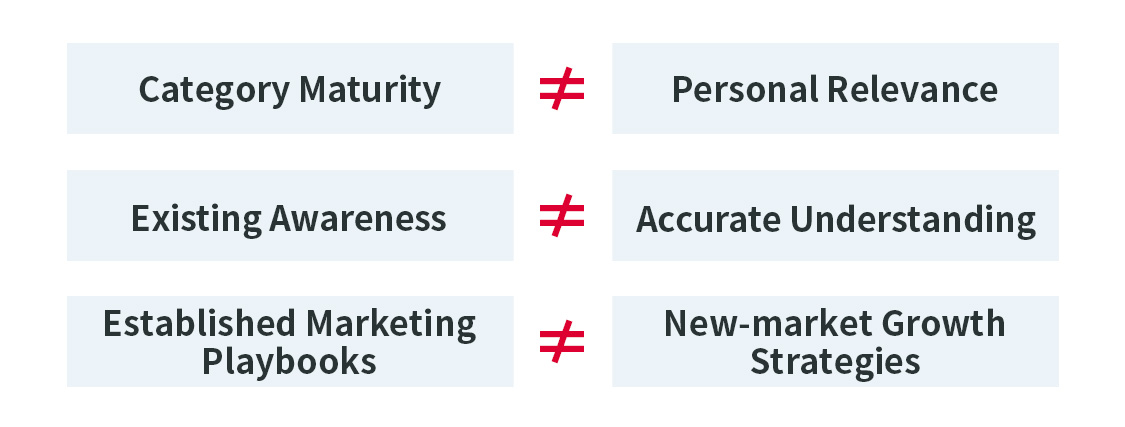
In practice, category maturity alone does not create demand. For a new audience, awareness has not yet been built, the connection to their needs has not yet formed, and behavior is even harder to activate… The market education results and marketing logic that worked for the core audience often cannot be directly replicated for a new target audience.
The challenge for brands is not simply to reach more audiences, but to shape awareness and activate demand for an incremental market and an entirely new audience. Through extensive consumer health project experience, cbh (Consumer & Big Health) team, an Illuminera boutique, has found that when a mature category enters a new audience market, brands need to consider three key questions: what characterizes the new audience, how to shape awareness, and how to activate key groups to take action.
Demand Activation Starts with Understanding Consumers

Unlike mature markets, new audiences are often still at the stage of demand cultivation. They have not yet formed a clear awareness of their needs and may not even realize that the product has any connection to them, let alone actively pay attention or take action.
Therefore, the first step in creating demand is to understand consumers themselves: to understand them first as people, rather than defining them solely as patients or product users, and to look for the connection between the “people” and the category, as well as the underlying motivations that drive action.
In practice, the cbh team has found that traditional demographic labels such as age, gender, and income cannot fully explain consumer behavior and offer little to build marketing on. The truly valuable insights are often found in consumers’ lifestyles - for example, what captures their attention, what they believe, what their spending habits are, which information channels they use, and in what situations they make decisions.
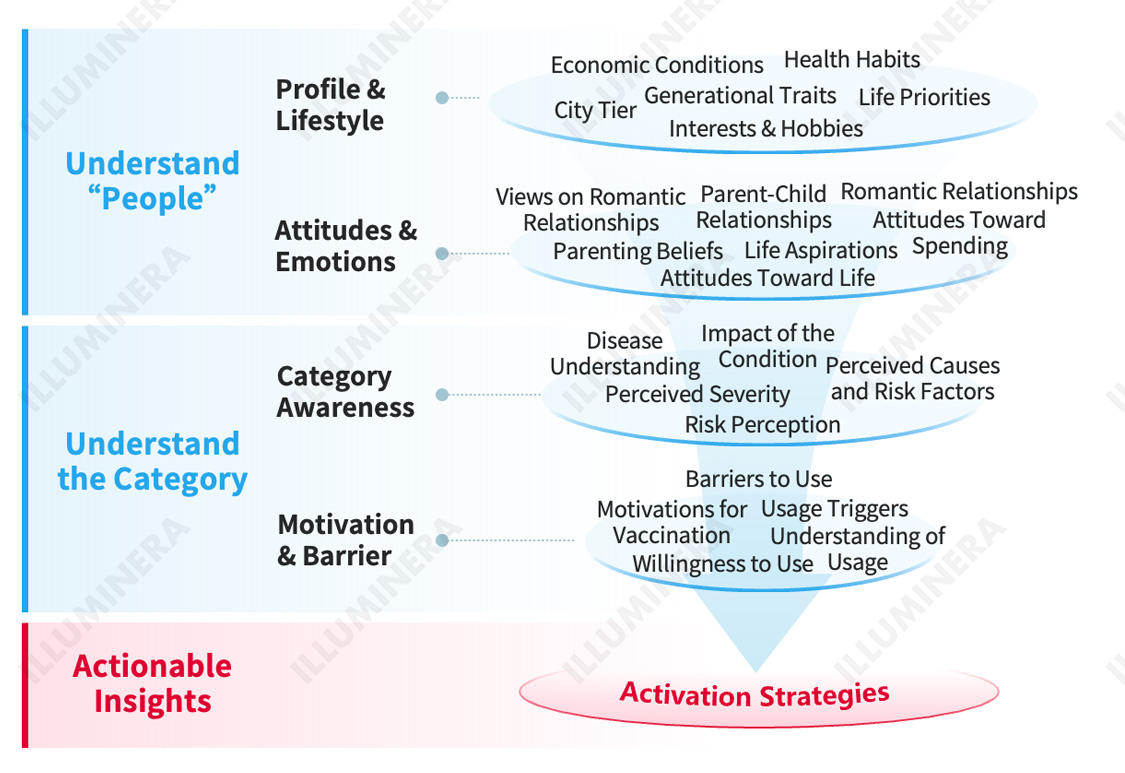
For new audiences, consumers do not make decisions in a single setting; they continually form judgments and choices throughout their daily lives. Therefore, brands need to step beyond a product perspective, develop a holistic understanding of consumers, and find the real points of connection between the category and consumers, so that they realize, “This actually has something to do with me”.
That sense of relevance is exactly where demand activation begins.
Effective Market Education Goes Beyond Communication to Shape Awareness

In consumer health, market education is often an issue that must be addressed when opening up new audience markets.
In many market education projects, brands tend to equate “consumers aware” with “consumers will act”. However, research shows that the journey from awareness to action is rarely linear. Consumers often drop off at multiple points along the way:
Some may have heard of the relevant concept but do not fully understand it or see its relevance to their own lives.
Some may understand the information but remain unconvinced due to a lack of firsthand experience or relatable examples.
Others may recognize the value but still hesitate because of unresolved concerns or practical barriers.
Therefore, building awareness in a new audience market is not simply a matter of spreading information, but of building an awareness system centered on shaping demand. Drawing on long-term consumer research experience, the cbh team has developed a trackable system that follows consumers from awareness to action, covering a three-layer awareness structure: “Awareness - Knowledge - Perception”.
Consumers need not only to encounter information, but also to build understanding and form agreement, and ultimately to develop a willingness to act, before demand truly takes shape.

For brands, the goal of market education should not stop at exposure; what matters more is moving consumers step by step from “awareness” to “perception” and “action”. Building a quantifiable, trackable set of indicators around the different stages of awareness, and continuously monitoring changes in awareness, helps uncover latent demand and ultimately turn it into market growth.
Incremental Growth Is Not About Reaching More People, but Activating the Right Ones

When a brand identifies a new incremental market opportunity, it is often facing a large and highly diverse population.
Consumers also differ significantly in the intensity of their needs, their level of acceptance, and their willingness to act. A conventional, mass-market approach to communication not only consumes substantial resources but also makes effective conversion difficult.
Therefore, once consumer insight and the awareness framework are in place, a key question confronts the brand: who is most valuable to activate first?
A large market does not necessarily mean a large opportunity—
In an incremental market, the largest group is not necessarily the most valuable one. The groups truly worth investing resources in first are often those whose demand forms faster, who convert more efficiently, and who also have the capacity to influence others. On this basis, the cbh team develops segmented audience personas (TA profiles) to gain a deeper understanding of different consumer groups, including their motivations, decision barriers, content preferences, and information touchpoints. This helps brands prioritize high-potential segments and tailor communication strategies to drive more effective activation.
For an incremental market, growth has never been about reaching more people, but about first activating the key groups. Only when the core group forms awareness, takes action, and goes on to influence those around them does market education enter a true stage of diffusion. As the consumer health industry enters an era of competition for share in increasingly saturated markets.
END
As competition intensifies across established consumer health categories, future growth may increasingly come from new consumer segments. Unlocking these opportunities requires more than expanding reach. Brands need to understand how consumers live and make decisions, build awareness in a structured and measurable way, and prioritize the segments most likely to take action and influence others.
Drawing on experience across FMCG and healthcare, Illuminera helps brands identify these opportunities and translate consumer insights into practical activation strategies.

For more relevant information, please send an email to marketing@illuminera.com.